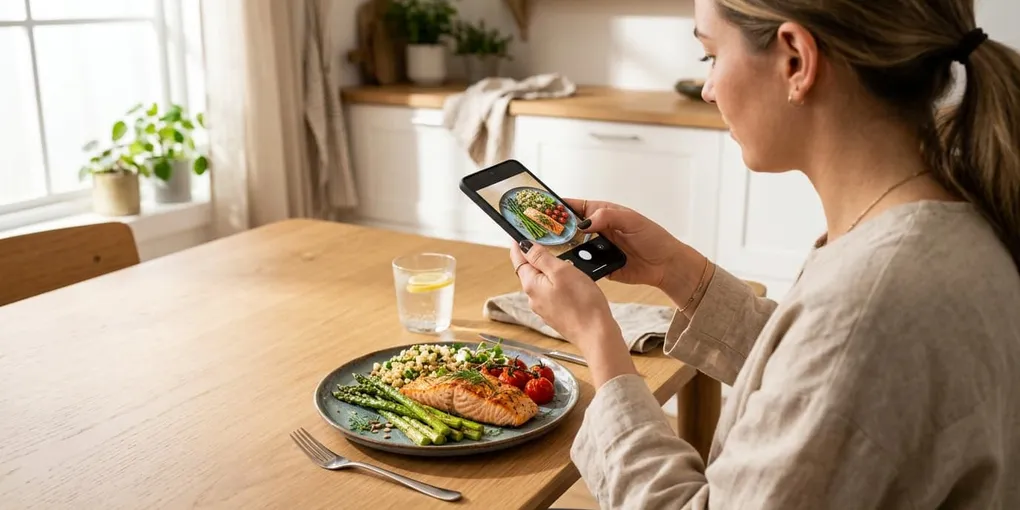
Why a Photo Food Diary Beats Manual Calorie Logging: Behavioral Psychology Insights
Tired of weighing grams and searching food databases? Discover why behavioral psychology proves taking a 3-second meal photo creates a mindful pause, reduces friction, and boosts adherence by 65%.
Key Takeaways
- The friction trap defeats willpower: Manual calorie logging requires up to 15 minutes of data entry daily, creating cognitive fatigue that drives 75-80% of users to quit within 4 weeks.
- The mindful pause transforms behavior: Snapping a meal photo introduces a 3-second pause between food impulse and eating, stimulating visual episodic memory and self-regulation.
- Visual tracking outperforms spreadsheets: Clinical trials show that photographic food records yield double the long-term adherence of text diaries by eliminating numerical anxiety.
- Zero-effort habit loop: Using a photo food journal alongside the Harvard Plate method allows you to evaluate meal proportions in 3 seconds directly in your browser.
Taking a photo of your food creates an immediate mindful pause before eating, activating nutritional self-awareness without the mental friction of searching calorie databases. Behavioral psychology shows that photo food journaling reduces tracking fatigue, takes only 2-3 seconds, and increases long-term dietary adherence by over 65% compared to tedious gram logging.
For decades, the health and fitness industry told us that achieving vibrant health required treating our kitchens like chemistry laboratories. We purchased digital gram scales, scanned barcodes on packaged goods, and typed every cherry tomato into massive calorie databases. Yet clinical data tells a sobering truth: more than three out of four people who start manual calorie tracking abandon the practice before thirty days pass. Many individuals find that the constant arithmetic triggers obsessive thoughts, which is why thousands now choose to stop calorie counting entirely. When we replace restrictive gram budgets with the visual proportions of the Harvard Healthy Eating Plate and leverage modern AI food recognition, we eliminate the food guilt and red numbers that derail our health habits.
Why Does Manual Calorie Logging Cause Behavioral Burnout?
Manual calorie logging causes behavioral burnout because it introduces severe cognitive friction, amplifies decision fatigue, and triggers the psychological all-or-nothing trap known as the abstinence violation effect.
To understand why traditional food diaries fail, we must look at how the human brain processes daily habits. In cognitive psychology, Nobel laureate Daniel Kahneman distinguishes between System 1 (fast, intuitive, low-energy thinking) and System 2 (slow, analytical, resource-heavy thinking). Eating is fundamentally governed by System 1. When you sit down for lunch, your biological hunger signals and sensory cravings seek immediate satisfaction.
Manual calorie tracking forces your exhausted System 2 into the loop at the worst possible moment. Consider the actual workflow required to log a simple homemade salad with grilled chicken:
- You locate your kitchen scale, place the empty bowl on top, and press the tare button.
- You weigh each ingredient separately: romaine lettuce, diced cucumber, grilled chicken breast, pumpkin seeds, and feta cheese.
- You unlock your phone, navigate past banner ads or subscription prompts, and open a search bar.
- You search the database for grilled chicken breast, only to be confronted with 45 crowdsourced entries with contradictory calorie values.
- You measure the olive oil dressing with a tablespoon or attempt to guess how many grams remained on the side of the pan.
- You repeat this entire sequence three to five times every single day.
This administrative overhead represents extreme behavioral friction. In behavioral economics, every additional click, second of delay, or complex calculation reduces the likelihood that an action becomes an automated habit. After two or three weeks, life happens: you work late, dine at a restaurant with friends, or travel for a weekend. The moment you cannot weigh an unlisted meal, your streak breaks.
Furthermore, traditional apps compound this fatigue by turning food into a moral scorecard. When an unexpected dessert pushes your daily total fifty calories over budget, the interface flashes red. In psychology, this triggers the abstinence violation effect: the belief that because perfection is ruined, the entire day is a write-off. The resulting guilt frequently leads to evening overeating and complete abandonment of the tracker.
How Does a Photo Food Journal Trigger Mindful Eating?
A photo food journal triggers mindful eating by creating a brief cognitive interruption called the mindful pause, shifting evaluation from abstract numbers to rich visual awareness.
When you take a photo of your meal before taking your first bite, something remarkable happens in your brain. You are not entering numbers into a cold ledger. Instead, you are capturing a vivid visual portrait of what you are about to put into your body. This simple action takes approximately 2-3 seconds, yet it interrupts the mindless autopilot that so often characterizes modern eating.
Behavioral scientists call this mechanism the Mindful Pause. In our hurried routines, we often begin eating while answering emails, scrolling through social media feeds, or watching television. Food enters our mouths without conscious registration, which delays the brain from receiving sensory satiety cues. Taking a photo introduces a gentle checkpoint. For those few seconds, your attention anchors firmly in the present moment:
- Visual Pattern Recognition: Your visual cortex processes the plate holistically. Without doing math, you immediately notice if your dish is completely beige (refined grains and meat) or vibrant with green, red, and orange produce.
- The Photographic Mirror Effect: Looking at a photo of your meal on your smartphone screen provides psychological distance. It allows you to view your food through the lens of an objective observer, activating self-regulation without harsh inner judgment.
- Enhanced Satiety Memory: Neurological research indicates that visual memory plays a crucial role in appetite regulation. When your brain forms a clear mental snapshot of a complete, colorful meal, you experience significantly less hunger and fewer cravings several hours later.
- Zero Friction Habit Formation: Because taking a photograph requires no database searching or gram estimation, it requires almost zero mental effort. It fits effortlessly into social dinners, family gatherings, and quick office lunches.
Rather than obsessing over whether a portion of avocado contains 140 or 170 calories, a photo allows you to ask a far more empowering question: Does this plate look colorful, balanced, and nourishing?
What Do Clinical Studies Reveal About Visual Tracking Adherence?
Clinical studies reveal that photographic food journaling produces adherence rates up to 65% higher than manual text logging while fostering healthier psychological relationships with food.
Nutrition researchers have long struggled with the unreliability of self-reported dietary records. In traditional written food logs, participants routinely underreport their intake by 20% to 40%, either due to memory failure or social desirability bias. Over the past fifteen years, clinical trials comparing visual food records against manual diaries have demonstrated consistent advantages for image-based tracking:
In a seminal study published by Dr. Lydia Zepeda and David Deal in the International Journal of Consumer Studies, researchers examined the behavioral impact of photographic food diaries. Participants who photographed their meals reported an immediate increase in nutritional awareness. The visual record acted as a powerful behavioral feedback loop: seeing their meals displayed chronologically made participants naturally choose smaller portions of processed foods and double their intake of fresh fruits and vegetables. Most importantly, participants maintained the photo habit throughout the intervention, whereas written diary groups suffered heavy attrition.
Similarly, a systematic review and meta-analysis led by Dr. Eric Robinson at the University of Liverpool explored the role of memory and attention in food consumption. The researchers analyzed multiple controlled feeding experiments and confirmed that attentive eating and episodic meal recall directly reduced subsequent food intake by approximately 10% to 15%. When eaters vividly remember what they ate at lunch through visual cues, their afternoon impulse snacking drops dramatically.
| Metric and Feature | Traditional Manual Tracking (MyFitnessPal, Yazio) | Mindful Photo Food Journal (PlateTracker) |
|---|---|---|
| Time per Meal | 3-5 minutes of typing and searching | 2-3 seconds to snap a photo |
| Kitchen Scale Requirement | Strictly required for stated accuracy | Completely unnecessary (visual balance) |
| Cognitive Friction | High (search fatigue, ingredient disambiguation) | Near zero (instant image capture) |
| Dining Out Usability | Nearly impossible (hidden restaurant recipes) | Effortless (works on any plate in 3 seconds) |
| Psychological State | Numerical anxiety, guilt over red overages | Curiosity, mindful pause, visual pride |
| 30-Day User Adherence | 20-25% (majority abandon app) | 70-85% (sustainable lifestyle habit) |
| Focus of Awareness | Abstract calories and isolated grams | Food quality, color diversity, plate proportions |
| Long-Term Habit Impact | Fosters dependency on digital databases | Trains your eyes to balance meals for life |
As the comparison reveals, manual calorie counting trades long-term sustainability for an illusion of numerical precision. A photo food journal, by contrast, operates in alignment with human behavioral psychology, turning self-monitoring from a resented chore into an enjoyable ritual.
How Can You Build a Sustainable Photo Logging Habit in 3 Steps?
You can build a sustainable photo logging habit by lowering friction to zero, anchoring your meals to the Harvard Plate proportions, and replacing numerical judgment with visual curiosity.
Transitioning from stressful macro spreadsheets to a peaceful photo journal does not mean abandoning accountability. In fact, visual tracking often provides far greater clarity regarding your actual dietary patterns. Here is how to establish an enduring habit in three practical steps:
Step 1: Lower the Barrier to Absolute Zero
Do not download bloated native apps that demand payment details or bombard you with notifications. Keep your tracking tool accessible with a single tap. Bookmark PlateTracker on your mobile home screen. Make an agreement with yourself: before your fork touches the food, take 3 seconds to take a clear top-down photo of your dish. There are no forms to fill out, no barcodes to scan, and no gram weights to record.
Step 2: Use the Harvard Plate Blueprint as Your Compass
Instead of guessing whether your calories are correct, evaluate your plate against the three intuitive sectors of the Harvard Healthy Eating Plate:
- 50% Vegetables and Fruits: Aim to fill half your dish with greens, roasted cruciferous vegetables, peppers, carrots, or fresh salads. This ensures high volume, hydration, and fiber.
- 25% Healthy Protein: Dedicate a quarter of your plate to palm-sized portions of baked fish, tender poultry, eggs, tofu, lentils, or beans to preserve lean muscle and ensure satiety.
- 25% Intact Whole Grains: Reserve the final quarter for wholesome carbohydrates like brown rice, quinoa, buckwheat, oats, or boiled sweet potatoes for stable blood sugar.
Step 3: Let AI Handle the Analysis While You Enjoy Your Meal
When you want instant feedback, allow intelligent computer vision to evaluate your plate. PlateTracker analyzes your photograph in 2-3 seconds, verifying whether your meal satisfies the 50/25/25 proportions and identifying opportunities to add more fiber or protein. You gain expert nutritional validation without spending a single minute doing math.
Frequently Asked Questions (FAQ)
Can I lose weight effectively using a photo food diary without counting calories? Yes. Weight management is fundamentally governed by dietary energy density and hormonal satiety, not micro-calculations. When you use a photo diary to build meals with 50% fiber-rich vegetables and 25% protein, you naturally reduce your daily caloric intake by 300-500 kcal without experiencing biological hunger or weighing food.
How does a photo diary help with mixed meals like soups, stews, and bowls? A photo diary remains exceptionally effective for mixed dishes because the primary psychological benefit is the mindful pause. Even when ingredients are blended, taking a photo encourages you to reflect on what is in the bowl. Furthermore, modern multimodal vision models in PlateTracker recognize hidden protein and vegetable components in complex culinary preparations.
Do I need to take a photograph of every single cup of tea, coffee, or water? No. Over-tracking liquid refreshments or tiny sips reintroduces the very friction you are trying to eliminate. Focus your photo journal on your main meals (breakfast, lunch, and dinner) and substantial snacks. This captures 95% of your nutritional intake while keeping the habit light, enjoyable, and sustainable for life.
Start Your Mindful Photo Food Diary in 3 Seconds
Healthy nutrition should bring peace of mind, vitality, and enjoyment to your table, not mathematical headaches or digital guilt. Open PlateTracker in your smartphone browser right now. Snap a quick photo of your next plate and let our intelligent AI verify your meal balance in 3 seconds without kitchen scales, subscriptions, or calorie stress.
Sources
- Robinson, E., Aveyard, P., Daley, A., et al. (2013). Eating attentively: a systematic review and meta-analysis of the effect of food intake memory and awareness on eating. The American Journal of Clinical Nutrition, 97(4), 728-742. https://doi.org/10.3945/ajcn.112.045245
- Zepeda, L., & Deal, D. (2008). Think before you eat: photographic food diaries as intervention tools to change dietary habits and promote weight loss. International Journal of Consumer Studies, 32(6), 691-698. https://doi.org/10.1111/j.1470-6431.2008.00725.x
- Harvard T.H. Chan School of Public Health (2023). Healthy Eating Plate. https://nutritionsource.hsph.harvard.edu/healthy-eating-plate/
Check Your Plate Balance by Photo
Snap your meal in PlateTracker. AI determines Harvard Plate proportions and nutrients in 3 seconds without scales.