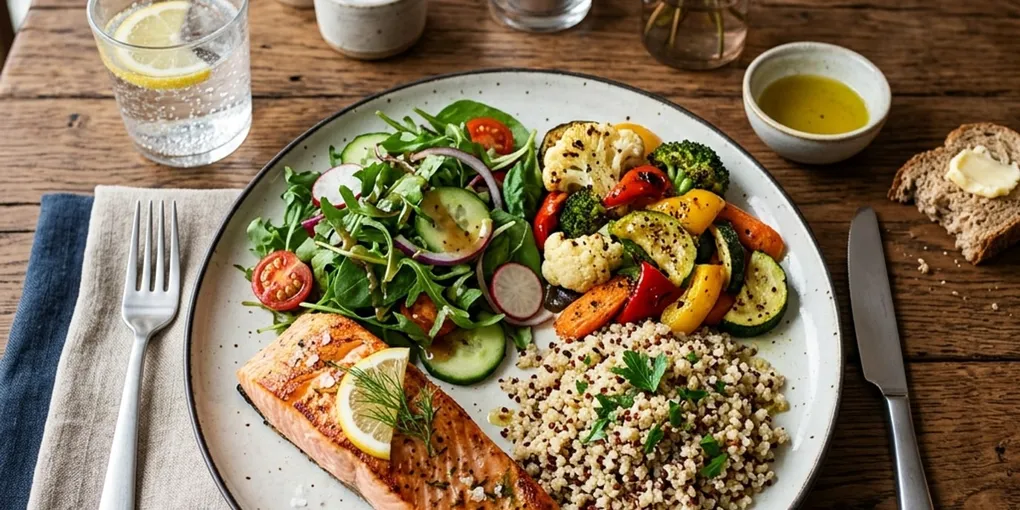
How to Eat Out Without Ruining Your Nutrition: The Restaurant Plate Method
Dining out without dietary guilt or kitchen scales. Learn how to adapt the Harvard Healthy Eating Plate at restaurants, canteens, and takeaway.
Key Takeaways
- Ditch the scale at restaurants: Healthy dining out relies on visual proportions rather than interrogating waiting staff about hidden cooking oil or exact gram weights.
- The First-Plate Rule: Always order a generous side salad or steamed vegetable plate first so that plants visually occupy 50% of your total meal volume.
- Hidden calories will not derail you: When you maintain the 1/2 non-starchy vegetable, 1/4 lean protein, and 1/4 complex carb balance, dietary fiber naturally buffers extra sauces and regulates post-meal blood glucose spikes.
Following healthy eating at restaurants requires simple visual heuristics instead of asking waiters for exact gram weights. Order a vegetable-dominant side dish to cover half your plate, choose grilled or baked protein for one quarter, and fill the remaining quarter with whole grains or steamed root vegetables.
Business lunches, client dinners, and weekend dates frequently turn into an anxious ordeal for anyone trapped in manual calorie logging. Pulling out a smartphone app at a restaurant table, guessing sauce volumes, and agonizing over unlisted butter quickly drains the joy out of socializing. As studies by Lorien Urban and colleagues in JAMA have shown, restaurant meals routinely vary by hundreds of calories from printed menu estimates, meaning manual tracking in restaurants is mostly an exercise in false precision.
Instead of relying on guesswork, you can apply the Harvard Healthy Eating Plate anywhere you dine. When you decide to stop calorie counting and focus on visual food groups, eating out becomes effortless. Chefs change recipes and portion sizes fluctuate, yet visual ratios keep your nutrition anchored without requiring a spreadsheet at the dinner table.
How Do You Apply the Plate Method When Dishes Are Pre-Mixed?
Complex restaurant dishes seem impossible to measure until you apply visual deconstruction. Request heavy dressings on the side, scan the main components of the dish, and rebalance your plate with an extra vegetable side before taking the first bite.
Take chicken pasta at a neighborhood bistro. In a typical restaurant serving, refined white pasta occupies 80% of the bowl, grilled chicken accounts for 20%, and non-starchy dietary fiber is practically zero. Eating that bowl as served delivers a massive glycemic load that leaves you sluggish an hour later.
How do you fix the ratio in ten seconds? Order a large side of grilled seasonal vegetables or a crisp garden salad dressed with olive oil and vinegar. Eat the vegetable dish first, finish all the chicken from the pasta bowl, and eat only half of the noodles. You can pack the remaining pasta for tomorrow or leave it behind, having built a balanced plate on the spot.
The same visual deconstruction works for burgers, curries, and stir-fries. When ordering a gourmet burger, swap the french fries for a side salad or roasted broccoli, and remove the top half of the brioche bun if the bread towers over the patty. For rich curries, ask for steamed vegetables alongside a single scoop of basmati rice so the sauce coats fiber and protein rather than a mountain of refined starch.
Which Restaurant Cuisines Are Easiest to Balance?
Every restaurant tradition offers clean protein and vegetable options alongside hidden calorie traps. Using the reference table below helps you scan any menu in thirty seconds and assemble a balanced meal without stress:
| Cuisine / Setting | Vegetables (1/2 Plate) | Lean Protein (1/4 Plate) | Complex Carbs (1/4 Plate) | What to Limit |
|---|---|---|---|---|
| Office Canteen / Diner | Steamed green beans, shredded cabbage salad, roasted tomatoes | Grilled chicken breast, baked cod, lean beef stew in light broth | Buckwheat, brown rice, boiled or baked potato halves | Deep-fried schnitzel, flour-thickened gravy, buttered mash |
| Italian Trattoria | Arugula with cherry tomatoes, grilled zucchini, eggplant, caprese | Seared calamari, baked sea bass, beef carpaccio, grilled shrimp | Half portion of al dente pasta or 1-2 thin crust pizza slices | Creamy carbonara, deep-dish four-cheese pizza, garlic bread baskets |
| Asian (Sushi & Wok) | Steamed edamame, bok choy, wakame and cucumber salad | Tuna or salmon sashimi, steamed tofu, grilled chicken skewers | Small bowl of steamed brown or jasmine rice, buckwheat soba noodles | Tempura batter, sugary teriyaki glaze, greasy fried rice |
| Mexican / Grill Bar | Fajita bell peppers and onions, pico de gallo, shredded lettuce | Grilled chicken breast, carne asada steak, black or pinto beans | Two small corn tortillas, small scoop of brown rice or quinoa | Crispy fried taco shells, melted queso dip, heavy sour cream |
| Mediterranean / Steakhouse | Greek village salad, grilled asparagus, roasted bell peppers | Grilled lamb skewers, souvlaki, filet mignon, grilled octopus | Half pita pocket, roasted sweet potato wedges, bulgur wheat | Deep-fried calamari rings, creamy garlic mayo, fries |
Why Does the “First-Plate Salad” Rule Prevent Overeating?
Sitting down at a restaurant after a ten-hour workday means your blood sugar is low and ghrelin levels are peaking. Trying to fight ravenous hunger with pure willpower while staring at a warm bread basket is a losing battle.
Beat biology with a simple physiological habit: order a large green salad or vegetable starter dressed with extra virgin olive oil and eat it before touching the bread or main course. Clinical research led by Barbara Rolls demonstrates that eating a low-energy-density first course significantly reduces total calorie intake across the entire meal without leaving diners feeling deprived.
This strategy works through mechanical and hormonal pathways. Fibrous vegetables and water physically stretch mechanoreceptors in the stomach wall, which dampens hunger signals traveling to the brain. Simultaneously, soluble fiber and healthy fats slow down gastric emptying and stimulate the release of glucagon-like peptide-1 (GLP-1) and peptide YY (PYY).
By the time your main course arrives fifteen minutes later, your appetite is calm and regulated. Furthermore, the viscous fiber matrix sitting in your digestive tract blunts the post-meal glucose and insulin spike from whatever carbohydrates you eat next. Applying the 50% vegetable rule for daily fiber turns out to be your strongest defense against restaurant overeating.
How Can You Balance Takeaway Containers, Business Lunches, and Buffets?
Takeaway meals, office delivery boxes, and hotel buffets are engineered for cheap volume, which usually means filling 70% of the container with white rice, noodles, or fries. Fixing these meals requires a two-step visual upgrade before you sit down to eat.
When ordering food delivery to your home or office, never rely on a single mixed box to cover your vegetable needs. Either add a dedicated side of steamed greens, cabbage slaw, or roasted vegetables from the menu, or keep washed salad leaves, cherry tomatoes, and canned beans in your fridge. Transfer half of the takeaway starch into a container for the next day, place the protein and remaining carbs onto a normal 9-inch dinner plate, and fill the empty half of the plate with your fresh greens.
Corporate buffets and all-you-can-eat events require a single-walk strategy. Walk along the entire buffet line once before picking up a plate so you know exactly where the steamed vegetables and lean proteins are located. Fill half of your plate with salads and cooked vegetables first, add grilled fish, poultry, or legumes to one quarter, and use the final quarter for starch or a small tasting portion of a rich dish.
Frequently Asked Questions (FAQ)
What should I do about hidden butter and cooking oil in restaurants? Commercial kitchens cook with generous amounts of butter and seed oils to enhance flavor. Accept this reality without anxiety. When 50% of your plate consists of fibrous, non-starchy vegetables and you avoid deep-fried batters or heavy cream sauces, your overall meal energy density drops naturally. Dietary fiber buffers extra cooking fat without requiring mathematical obsession.
Can I drink a glass of wine or beer with dinner? Alcohol does not fit into the macronutrient quarters of the plate method, as it provides empty energy without satiety. If you choose to enjoy a glass of dry wine or a light beer at dinner, savor it slowly alongside your food and alternate with a large glass of sparkling water. Never punish yourself by cutting out your protein or vegetable portions to save calories for drinks.
What if the restaurant or fast-food spot serves almost no vegetables? Roadside diners, airports, and fast-food joints sometimes offer zero fresh greens. In those situations, prioritize the protein quarter by ordering grilled chicken, a double burger wrapped in lettuce, or eggs, and skip sugary sodas. You can easily replenish your dietary fiber during your next meal at home by adding extra berries, beans, or roasted vegetables.
How do I handle shared appetizers and dessert menus? Shared starters like bruschetta, nachos, or fried calamari can quietly double your meal intake before the main course arrives. If the table orders shared plates, take one small portion onto your side plate alongside raw vegetables or olives. For dessert, apply the three-bite rule by ordering one dessert to share with the table paired with an espresso or herbal tea.
How Can You Analyze Restaurant Meals in 3 Seconds with AI?
Dining somewhere new and feeling uncertain whether your plate hits the right balance?
Skip the mental math and enjoy your company. Open PlateTracker, snap a quick photo of your dish right at the table, and our multimodal vision AI breaks your meal down into vegetable, protein, and carbohydrate proportions in under 3 seconds. No kitchen scales, no manual database searches, and zero social awkwardness.
Sources
- Harvard T.H. Chan School of Public Health: The Nutrition Source - Healthy Eating Plate. https://nutritionsource.hsph.harvard.edu/healthy-eating-plate/
- Rolls, B. J., Roe, L. S., & Meengs, J. S. (2004). Salad and satiety: energy density and portion size of a first-course salad affect energy intake at lunch. Journal of the American Dietetic Association, 104(10), 1570-1576.
- Urban, L. E., McCrory, M. A., Dallal, G. E., et al. (2011). Accuracy of stated energy contents of restaurant foods. JAMA, 306(3), 287-293.
Check Your Plate Balance by Photo
Snap your meal in PlateTracker. AI determines Harvard Plate proportions and nutrients in 3 seconds without scales.