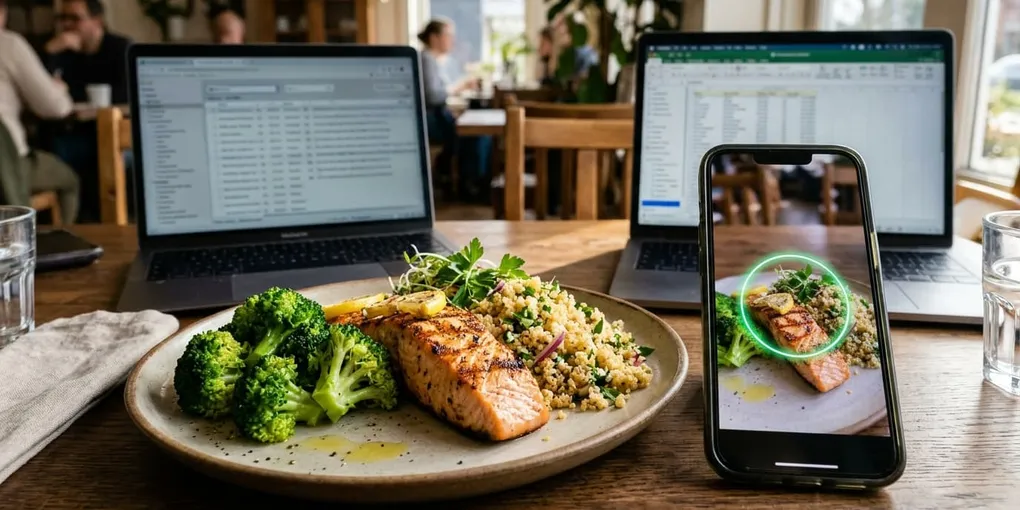
FatSecret and Lose It Alternatives: Why Manual Food Database Logging Is Obsolete
Discover why crowdsourced food databases in FatSecret and Lose It lead to tracking burnout, and learn how AI visual plate analysis replaces manual entry.
Key Takeaways
- Crowdsourced database chaos: Traditional calorie counters like FatSecret and Lose It rely on unverified user entries, creating massive discrepancies of up to forty percent in basic meal calories.
- Cognitive friction and logging fatigue: Typing ingredients, selecting serving sizes, and searching through dozens of duplicate recipes drains willpower, causing most dieters to quit within one month.
- The illusion of mathematical accuracy: Spending fifteen minutes calculating exact grams creates a false sense of precision while obscuring the overall nutritional balance of the meal.
- Instant visual plate verification: Modern computer vision analyzes meal proportions in three seconds against the Harvard Healthy Eating Plate, delivering reliable guidance without digital paperwork.
Manual food database searching in FatSecret and Lose It has become obsolete because crowdsourced libraries are flooded with inaccurate duplicates, turning daily meals into stressful bookkeeping chores. AI visual meal tracking replaces manual logging in three seconds, evaluating whole food proportions and nutrient quality without requiring kitchen scales or keyword searches.
For more than fifteen years, mobile fitness apps convinced millions of people that successful weight management required cataloging every meal like an invoice. Whenever you sat down to eat, you had to unlock your phone, open FatSecret or Lose It, type the name of your dish into a search bar, and scroll through an endless list of conflicting entries. One user logged a bowl of lentil soup as ninety calories, while another logged the exact same portion as four hundred calories. What was meant to build healthy discipline quickly morphed into cognitive exhaustion. By reviewing the foundational principles in the Harvard Healthy Eating Plate guide, understanding why you should stop counting calories permanently, examining the best MyFitnessPal alternatives without kitchen scales, and exploring the behavioral psychology of why a photo food diary beats manual logging, you can free yourself from database fatigue for good.
Why Are Crowdsourced Food Databases in FatSecret and Lose It Full of Errors?
Crowdsourced food databases in FatSecret and Lose It are full of errors because millions of unmoderated user entries contain wild discrepancies, missing micronutrients, and inaccurate serving sizes.
When food tracking applications first launched, developers faced a monumental challenge: indexing hundreds of thousands of grocery items, restaurant dishes, and regional recipes. To scale their product catalogs without hiring massive dietitian teams, companies allowed open community submissions. That crowdsourcing decision created four systemic flaws:
- Duplicate record explosion: Searching for plain oatmeal yields hundreds of conflicting entries created by different users. Some entries count dry flakes, others count cooked porridge with water, and several include hidden milk or sugar without specifying details in the title.
- Gross macronutrient inaccuracies: Users frequently misread nutrition labels or deliberately alter numbers to make their daily logs appear lower in calories. Laboratory audits of public database entries regularly uncover discrepancies exceeding thirty percent between logged values and chemical food analysis.
- Missing essential micronutrients: Most community submissions only record total calories, ignoring dietary fiber, potassium, calcium, and healthy fats. An app may show that your calorie budget looks fine while your body suffers from severe micronutrient starvation.
- Disappearing restaurant formulas: Chain restaurants continuously change cooking oils, portion sizes, and seasoning recipes. User entries submitted five years ago remain active in the database, misleading users who assume the figures reflect current kitchen practices.
Instead of providing clarity, manual databases force you to become an unpaid investigative auditor before every lunch and dinner.
How Does Manual Keyword Logging Drain Your Willpower and Energy?
Manual keyword logging drains your willpower and energy by creating persistent decision fatigue that transforms natural eating into a high-friction administrative task.
Behavioral scientists know that human self-control operates like a rechargeable battery. Every micro-decision you make throughout a busy workday depletes your cognitive reserves. When mealtime arrives, manual food logging introduces a barrage of exhausting hurdles:
1. The Serving Size Guessing Game
- Cognitive burden: A tracking app asks whether your side dish measured one cup, two hundred grams, three fluid ounces, or four tablespoons.
- Psychological consequence: Without carrying a digital scale to your workplace or restaurant, you are forced to guess, generating quiet background anxiety that your tracking record is flawed.
2. Search Result Overload
- Cognitive burden: Entering a simple phrase like chicken salad generates dozens of wildly different entries ranging from two hundred to eight hundred calories.
- Psychological consequence: Deciding which entry to tap requires mental effort. After days of repetitive scrolling, users experience decision fatigue and abandon tracking altogether.
3. Destruction of Dining Mindfulness
- Cognitive burden: Instead of admiring colors, aromas, and textures, you stare at a glowing smartphone screen while your warm food grows cold.
- Psychological consequence: The sensory pleasure of nourishment vanishes, replaced by stress over hitting arbitrary mathematical macros.
How Do FatSecret, Lose It, and PlateTracker Compare Head-to-Head?
FatSecret, Lose It, and PlateTracker represent fundamentally different eras of nutritional science, contrasting legacy keyword entry against modern visual proportion analysis.
To understand why the fitness industry is rapidly pivoting toward visual meal verification, examine how these tools perform across daily lifestyle criteria:
| Comparison Metric | FatSecret | Lose It! | PlateTracker |
|---|---|---|---|
| Core Tracking Method | Manual keyword search in database | Manual search and barcode scanning | Three-second AI visual recognition |
| Daily Time Investment | 15 to 20 minutes across meals | 12 to 18 minutes across meals | Under 15 seconds per day |
| Reliance on Kitchen Scales | High (requires gram measurements) | High (demands exact portion units) | Zero (evaluates plate surface ratios) |
| Database Accuracy Risk | High (millions of unverified duplicates) | Moderate to High (user submissions) | Deterministic (Harvard Plate guidelines) |
| Mental Guilt Triggers | Red calorie warnings and deficits | Over-budget alerts and streaks | Positive focus on nutrient balance |
| Barrier to Entry | Cluttered forum interface | Heavy paywalls and upsells | Free browser app, no install required |
Legacy apps treat nutrition like a rigid financial ledger where every calorie represents a dollar spent. In contrast, modern visual tracking assesses food quality, fiber volume, and structural balance, aligning seamlessly with human physiology.
What Makes Visual Plate Recognition Superior to Manual Database Searches?
Visual plate recognition is superior to manual database searches because it captures the true composition of real meals instantly, prioritizing whole foods over isolated calorie numbers.
When you look down at a balanced meal, your health does not hinge on whether your baked salmon weighed one hundred and forty or one hundred and fifty grams. What matters metabolically is whether your plate contains enough high-quality protein to maintain muscle, sufficient fibrous vegetables to blunt glucose spikes, and moderate unrefined carbohydrates to fuel activity. Computer vision excels at this exact evaluation:
1. Instant Geometry and Proportion Assessment
- How it works: Machine vision models analyze the visual surface area of your ceramic plate, segmenting non-starchy vegetables, lean proteins, and complex grains within seconds.
- Metabolic advantage: You receive immediate verification that your meal matches the golden fifty-twenty-five-twenty-five Harvard distribution without typing a single word.
2. Elimination of Fake Precision
- How it works: Visual tracking rejects the false premise that mobile calorie databases can measure real human digestion to the single digit.
- Metabolic advantage: By focusing on volume density and meal architecture, you establish sustainable habits that remain effective whether you cook at home or dine out.
3. Preservation of the Mindful Pause
- How it works: Snapping a quick picture creates a pleasant two-second pause of appreciation before you take your first bite.
- Metabolic advantage: You stay present with your food, chew thoroughly, and tune into biological satiety signals rather than obsessing over an app ledger.
How Can You Transition from Tedious Manual Tracking to Visual Freedom?
You can transition from tedious manual tracking to visual freedom by deleting crowdsourced logging apps, embracing visual plate portions, and adopting photo-based verification.
Leaving behind years of manual logging requires resetting your relationship with food metrics. Take these four practical steps:
1. Retire the Exhausting Database Search Habit
- Action: Delete tracking apps that demand endless typing and hide your kitchen scale in a high cabinet.
- Benefit: Instantly reclaim fifteen minutes of mental energy each day and eliminate the stress of selecting between conflicting recipe entries.
2. Adopt the Universal Half-Plate Produce Rule
- Action: Before serving any starches or meats, cover fifty percent of your plate with colorful vegetables, leafy greens, or raw salads.
- Benefit: Generous dietary fiber stretches gastric mechanoreceptors naturally, delivering genuine fullness without calculating calories.
3. Anchor Every Meal with Quality Protein and Whole Grains
- Action: Fill one-quarter of your dish with wild fish, poultry, eggs, tofu, or beans, and reserve the final quarter for brown rice, quinoa, or potatoes.
- Benefit: You guarantee complete amino acid profiles and steady glucose delivery without opening an ingredient database.
4. Verify Meals with a Three-Second Photo
- Action: Whenever you want objective confirmation, take a photo in the PlateTracker web app.
- Benefit: Computer vision audits your proportions against Harvard standards in three seconds directly in your mobile browser, giving you peace of mind with zero paperwork.
Frequently Asked Questions About FatSecret, Lose It, and Visual Tracking
Are manual calorie counting apps accurate for home-cooked meals?
No. Home-cooked stews, stir-fries, and casseroles vary dramatically based on cooking time, moisture reduction, and specific oil brands. Attempting to match a home recipe to a generic crowdsourced entry in FatSecret or Lose It produces errors of twenty to forty percent.
Will I regain weight if I stop searching databases and measuring grams?
If you transition to the Harvard plate method, your body maintains a natural, stable energy balance. The high volume of water and fiber in non-starchy produce combined with the satiating effect of clean protein prevents overeating without requiring mathematical counting.
Does visual plate recognition work for mixed dishes like bowls and stews?
Yes. Modern computer vision models identify mixed ingredients and evaluate the relative density of leafy greens, proteins, and carbohydrates within bowls, curries, and salads, categorizing the dish reliably.
Why do apps like FatSecret and Lose It promote paid premium tiers?
Legacy calorie counters rely on complex subscription models, locking basic tools like barcode scanners, nutrient breakdowns, or ad-free logging behind paywalls. In contrast, modern browser-based tools focus on accessible visual wellness without aggressive monetization traps.
Sources
- Harvard T.H. Chan School of Public Health. The Healthy Eating Plate. Harvard University, Boston, MA.
- Chen, J., et al. (2019). Accuracy of crowdsourced nutrition databases in smartphone applications. Journal of Medical Internet Research, 21(10), e14285.
- Robinson, E., et al. (2013). Eating attentively: a systematic review and meta-analysis of the effect of food intake memory and awareness on eating. The American Journal of Clinical Nutrition, 97(4), 728-742.
- Rolls, B. J. (2014). Dietary energy density: Applying behavioural science to weight management. Nutrition Bulletin, 39(1), 36-43.
- Vartanian, L. R., et al. (2008). The psychology of portion size: When and why large portions lead to increased consumption. Journal of Marketing Research, 45(5), 583-591.
Check Your Plate Balance by Photo
Snap your meal in PlateTracker. AI determines Harvard Plate proportions and nutrients in 3 seconds without scales.