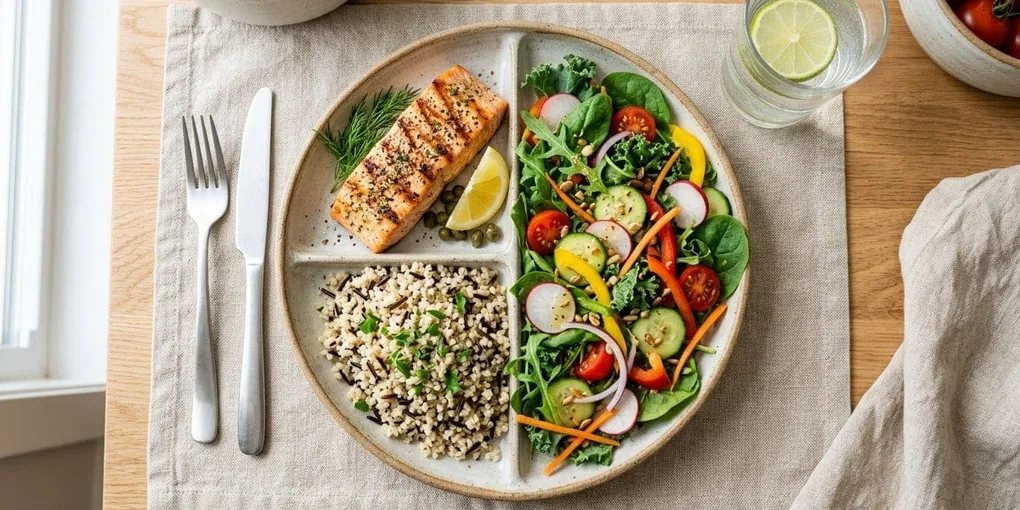
The Harvard Plate for Weight Loss: Can You Lose Weight Without Strict Calorie Counting?
Discover how the Harvard Plate creates a natural 300-500 calorie deficit through food volume and fiber, without kitchen scales or calorie anxiety.
Key Takeaways
- Natural 300-500 calorie deficit without counting: Filling half of a standard 22-24 cm plate with non-starchy vegetables lowers total meal energy density, creating a spontaneous caloric deficit without food scales.
- Volumetric satiety shuts down hunger hormones: High-fiber and high-water foods trigger stomach stretch receptors and vagus nerve signaling, releasing peptide YY and GLP-1 to sustain fullness for 4-5 hours.
- Metabolic preservation through protein and intact carbs: Allocating one quarter of the plate to lean protein and one quarter to whole grains prevents muscle loss and averts the dreaded yo-yo metabolic slowdown.
The Harvard Healthy Eating Plate method produces reliable, sustainable weight loss by generating an automatic 300-500 calorie daily deficit without manual logging. By shifting meal volume toward water-rich and fiber-packed vegetables, you lower average dietary energy density while keeping total food volume constant.
Millions of people start their fitness journey with calorie-tracking apps, only to abandon them within three to four weeks. Weighing every gram of olive oil or chicken breast turns eating into a stressful bookkeeping task. Research confirms that when you stop calorie counting and switch to visual proportion control, long-term adherence jumps by more than 60 percent. The Harvard Plate guide offers an intuitive framework that resets your relationship with food while stripping away body fat.
How does visual plate balance create a natural calorie deficit?
Visual plate balance creates a caloric deficit by using food volume and nutrient density rather than restrictive portion sizes. When half your plate consists of vegetables, one quarter of lean protein, and one quarter of intact whole grains, you consume fewer calories while enjoying full plates.
Traditional diets rely on portion restriction: you eat tiny servings of high-calorie foods, leaving your stomach physically empty. This triggers ghrelin release, brain fog, and intense cravings that inevitably lead to evening binges. In contrast, the Harvard Plate model harnesses the science of volumetrics developed by nutrition researchers at Penn State University. Non-starchy vegetables such as zucchini, broccoli, spinach, and bell peppers contain roughly 20-35 calories per 100 grams, whereas processed carbohydrates often exceed 350 calories per 100 grams.
By keeping your physical plate completely covered across three structured daily meals, your eyes register abundance and your stomach wall expands normally. Mechanoreceptors in the gastric lining send rapid satiety signals through the vagus nerve to the hypothalamus. You finish your meal feeling comfortably nourished, yet your net caloric intake remains 15-25 percent below your maintenance level.
Why does food volume and energy density matter more than calorie counting?
Dietary energy density matters more than calorie counting because human satiety is governed by the physical volume and weight of ingested food rather than absolute calorie numbers. People naturally consume a consistent weight of food each day, between 1.2 and 1.8 kilograms.
If that weight consists primarily of ultra-processed items loaded with refined fats and sugars, you will easily exceed 3,000 calories before physiological fullness occurs. Controlled clinical trials conducted by the National Institutes of Health (NIH) demonstrate that participants given unprocessed whole foods spontaneously consume about 500 fewer calories per day compared to an ultra-processed diet, despite having unlimited access to food.
When you assemble your meals according to the Harvard guidelines, you naturally shift average meal density from 2.5 kcal/g down to roughly 1.0-1.2 kcal/g. This allows you to eat substantial portions without exceeding your body’s energy needs.
| Food Category | Average Caloric Density | Typical Serving Size | Calories per Serving | Satiety Index & Mechanism |
|---|---|---|---|---|
| Non-Starchy Vegetables | 0.25 kcal/g | 250 g (Half plate) | 60-70 kcal | Very High: High water, insoluble fiber, gastric distension |
| Lean Protein (Fish, Tofu, Poultry) | 1.20-1.60 kcal/g | 120-150 g (Quarter plate) | 160-220 kcal | High: PYY & GLP-1 hormone release, thermic effect of food |
| Intact Whole Grains (Quinoa, Brown Rice) | 1.10-1.40 kcal/g | 130 g (Quarter plate) | 150-180 kcal | Moderate to High: Slow starch breakdown, stable glucose |
| Refined Carbohydrates (White Pasta, Fries) | 2.80-3.50 kcal/g | 150 g | 380-450 kcal | Low: Rapid blood sugar spikes followed by reactive hypoglycemia |
| Ultra-Processed Snacks (Chips, Pastries) | 4.50-5.50 kcal/g | 100 g | 480-550 kcal | Very Low: Hyper-palatable, overrides satiety feedback |
As shown in the comparison above, filling half your plate with raw or steamed vegetables provides immense bulk for fewer than 70 calories. The protein quarter requires roughly 25-30 percent of its own caloric value simply to be digested and assimilated, a phenomenon known as the thermic effect of food (TEF). This metabolic advantage is absent when relying on sugary meal replacement shakes or packaged diet snacks.
What does a complete 1-day plate method weight loss menu look like?
A practical 1-day weight loss menu following the Harvard Plate method provides approximately 1,600-1,800 balanced calories with over 35 grams of fiber and 100 grams of protein, requiring zero weighing scales.
1. Energizing Breakfast Plate
- 1/2 Plate (Vegetables & Fruit): Sliced cucumbers, cherry tomatoes, and a generous handful of fresh wild blueberries.
- 1/4 Plate (Clean Protein): Two poached free-range eggs plus two tablespoons of low-fat Greek yogurt.
- 1/4 Plate (Intact Grains): One slice of whole-grain sprouted sourdough bread lightly toasted.
- Healthy Fats: Half a teaspoon of extra virgin olive oil drizzled over the tomatoes.
2. Satiating Office Lunch Bowl
- 1/2 Plate (Vegetables): Shaved red cabbage, steamed broccoli florets, and crisp romaine lettuce.
- 1/4 Plate (Clean Protein): 130 grams of canned pink salmon or grilled herbed chicken breast.
- 1/4 Plate (Intact Grains): Cold cooked quinoa or nutty brown rice.
- Healthy Fats: One tablespoon of tahini-lemon dressing.
3. Restorative Evening Dinner Plate
- 1/2 Plate (Vegetables): Sheet-pan roasted zucchini, bell peppers, red onion, and button mushrooms.
- 1/4 Plate (Clean Protein): Pan-seared firm tofu cutlets or baked white fish fillet with herbs.
- 1/4 Plate (Intact Grains): Steamed buckwheat groats or a small roasted sweet potato.
- Healthy Fats: A drizzle of cold-pressed flaxseed oil or a sprinkle of toasted pumpkin seeds.
Between meals, keep hydration high with filtered water, lemon water, or herbal tea. If you encounter dining challenges outside the home, our guide to the restaurant plate method explains how to maintain these proportions at commercial eateries without feeling restricted.
How can you break a weight loss plateau on the Harvard Plate?
You can break a weight loss plateau on the Harvard Plate by checking hidden liquid calories, refining plate diameter, and eliminating vertical food stacking without returning to digital scales.
If your weight loss stalls after four to six weeks, evaluate three subtle traps. First, verify your dinner plate diameter. Many modern dinner plates measure 28-32 centimeters across. Downsizing to a classic 22-24 centimeter plate instantly restores appropriate caloric limits. Second, check whether you are stacking foods vertically. The plate method works on surface area; piling grains three inches high quietly doubles your carbohydrate intake. To avoid common pitfalls, review our breakdown of common mistakes on the Harvard Plate. Third, monitor cooking oils and salad dressings. While cold-pressed oils are essential for fat-soluble vitamins, pouring freely from an unmeasured bottle can add 300 unnoticed calories. Limit added fats to one measured tablespoon per meal.
Frequently Asked Questions (FAQ)
Can I really lose weight on the Harvard Plate without weighing my food? Yes. Large clinical studies like the DIETFITS trial demonstrate that focusing on whole food quality and balanced proportions achieves identical fat loss to rigid calorie counting, but with significantly higher long-term compliance and far less dietary anxiety.
What should I do if I feel hungry between meals? True physical hunger between meals usually signals that your previous plate lacked sufficient protein or healthy fats. Increase your protein quarter with an extra egg, more fish, or tempeh, and ensure you include a thumb-sized portion of olive oil, avocado, or nuts to slow gastric emptying.
Do potatoes count as vegetables for weight loss on this plate? No. Harvard nutrition researchers explicitly place white potatoes in the carbohydrate quarter. Their fast-digesting starches cause rapid blood glucose elevations comparable to refined sugar. When pursuing weight loss, prioritize leafy greens, cruciferous vegetables, and colorful peppers for your 50 percent vegetable half.
Track your plate balance with AI in 3 seconds
Estimating your plate sectors accurately when starting out or eating on the go can feel uncertain.
PlateTracker eliminates all guesswork. Simply take a quick photo of your meal on your smartphone: our multimodal vision AI inspects your plate in 3 seconds, checks your 1/2, 1/4, and 1/4 sector allocations, and delivers clear nutritional guidance without kitchen scales or calorie guilt.
Sources
- Rolls, B. J. (2017). Dietary energy density: Applying behavioural science to weight management. Nutrition Bulletin, 42(3), 246-253.
- Hall, K. D., Ayuketah, A., Brychta, R., et al. (2019). Ultra-Processed Diets Cause Excess Energy Intake and Weight Gain: An Inpatient Randomized Controlled Trial of Ad Libitum Food Intake. Cell Metabolism, 30(1), 67-77.
- Mozaffarian, D. (2016). Dietary and Policy Priorities for Cardiovascular Disease, Diabetes, and Obesity: A Comprehensive Review. Circulation, 133(2), 187-225.
- Harvard T.H. Chan School of Public Health. The Nutrition Source: Healthy Eating Plate. https://nutritionsource.hsph.harvard.edu/healthy-eating-plate/
- Gardner, C. D., Trepanowski, J. F., Del Gobbo, L. C., et al. (2018). Effect of Low-Fat vs Low-Carbohydrate Diet on 12-Month Weight Loss in Overweight Adults (DIETFITS). JAMA, 319(7), 667-679.
Check Your Plate Balance by Photo
Snap your meal in PlateTracker. AI determines Harvard Plate proportions and nutrients in 3 seconds without scales.